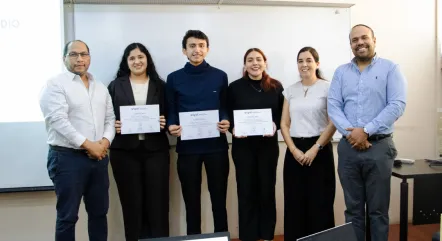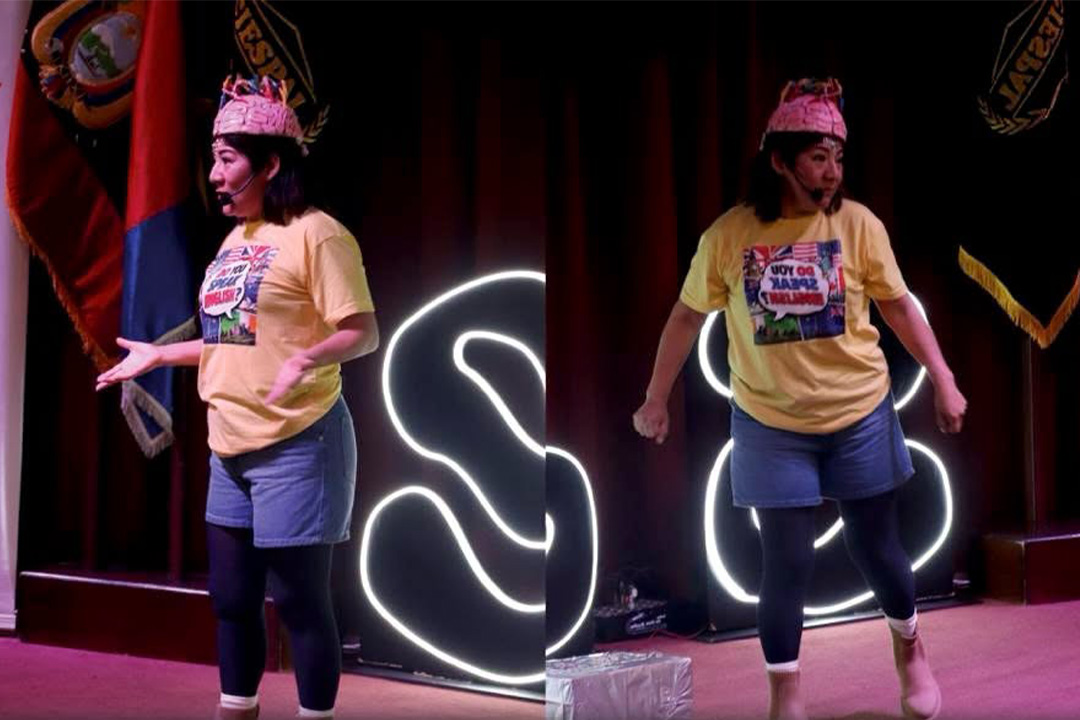

How do you explain, in three minutes, with humor and without a single slide, why the human brain is better equipped to learn English than we think? Katherine Salvador-Cisneros, an English professor at the Center for Foreign Languages (Celex) and a researcher at ESPOL's Faculty of Social and Human Sciences (FCSH), found the answer—and with it, took first place in the national scientific monologue contest Solo de Ciencia, Ecuador 2026.
The final took place on September 11 at the facilities of the International Center for Higher Studies of Communication for Latin America (CIESPAL) in Quito, where the researcher competed alongside four other finalists selected from among dozens of researchers from across the country. Her monologue, titled Your Brain Already Speaks English, won over the evaluation committee, which included Gissela Dávila Cobo, General Director of CIESPAL; Sara Cifuentes, winner of the previous edition; and Pepe Kaiser, a performing arts expert.
What sets Your Brain Already Speaks English apart is not just its subject, but the way it's told. Rather than an academic lecture, the professor built a dynamic, humorous monologue that draws on everyday experiences and interactive exercises with the audience to explain concepts such as neuroplasticity, learning through exposure and practice, and the cognitive benefits of bilingualism documented by neuroscientist Ellen Bialystok. Her approach reclaims mistakes—not as failure, but as an essential part of the language-learning process—and shows how emotions and songs directly affect memory.
With this first-place win, the FCSH researcher will represent Ecuador at the IV Ibero-American Final of the Solo de Ciencia scientific monologue contest, to be held in Costa Rica this November. The national contest was organized by the Ministry of Education, through the Vice Ministry of Higher Education, together with the Organization of Ibero-American States (OEI), Ecuador office, and the National Polytechnic School, with support from UNESCO and the Spanish Foundation for Science and Technology (FECYT), the original promoting entity of the initiative.