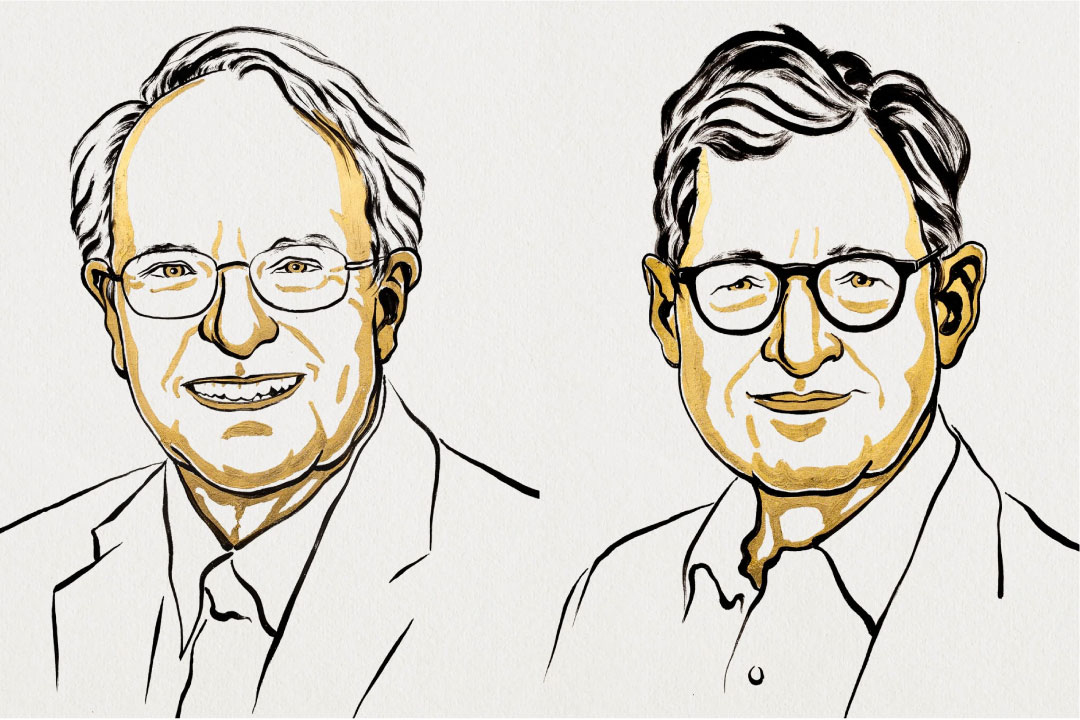


The Royal Swedish Academy of Sciences awarded the 2026 Nobel Prize in Economic Sciences to economists Robert E. Hall and Michael Woodford for their contributions to the microeconomic foundations of macroeconomic stabilization (Royal Swedish Academy of Sciences, 2026). Their research helps explain how expectations about future income shape consumption decisions, and how interest rates shape the saving and investment decisions of households and firms and, consequently, the aggregate behavior of the economy. These findings provide a theoretical basis for effective stabilization policies to control inflation and reduce fluctuations in economic activity.
From Keynesian Macroeconomics to Microeconomic Foundations
In the 1930s, the Great Depression popularized the Keynesian view of the economy, which explained economic dynamics well for its time, although it should be noted that this way of seeing the economy relies on statistical relationships among macroeconomic aggregates. However, the stagflation (recession with inflation) of the 1970s and the critique by Robert Lucas, awarded the Nobel Prize in 1995, showed that such relationships break down when people adjust their behavior in response to new policies, since models cannot predict changes if they do not consider how agents react. In this context, the discipline demanded a microfounded approach, built on the rational decisions of households and firms. Nevertheless, two gaps remained: i) how consumption is decided, since expectations about the future are not observable, and ii) how to integrate sticky prices into a model useful for central banks (Alberola, 2026; Royal Swedish Academy of Sciences, 2026).
Contribution to Science
Robert E. Hall
His work covers unemployment, consumer spending, taxation, labor market dynamics, and recessions. His main contribution is the study of household consumption decisions and their link to expectations about future income. In his 1978 research, Hall showed that, under the assumptions of the life-cycle and permanent income hypotheses, changes in consumption are essentially unpredictable from available information, since they respond to new information about future income (Hall, 1978).
Subsequently, Hall and Mishkin (1982), using household panel data, found that observed consumption behavior was consistent with the permanent income hypothesis for approximately 80% of families, while for the remaining 20% consumption responded more directly to changes in current income. These results show that households respond heterogeneously to changes in income, which has implications for the effects of fiscal and monetary policies.
Michael Woodford
His research focuses on understanding how monetary policy influences the decisions of households and firms, and how these decisions in turn determine the evolution of the economy. One of his main contributions was to highlight the role of expectations in the formation of inflation and economic activity: firms set their prices taking into account current and expected conditions, while households decide their consumption and saving according to their expectations about the economy and the interest rate. This framework incorporates nominal price rigidities, which prevent firms from adjusting their prices immediately in response to changes in economic conditions. These rigidities help explain why monetary policy can also affect output and employment in the short run (Woodford, 2003).
One of Woodford’s most relevant contributions is to point out that the effectiveness of monetary policy depends not only on the current level of interest rates, but also on expectations about their future path. For this reason, the credibility and communication of central banks are fundamental, since their announcements can influence economic behavior before the measures take effect.
These contributions are consolidated in Interest and Prices: Foundations of a Theory of Monetary Policy (2003). This work provided theoretical foundations for current monetary policy frameworks, such as interest rate rules, inflation targeting, and forward guidance, helping to explain how monetary policy can promote price stability and stability in economic activity.
Joint Contribution
The contributions of Robert E. Hall and Michael Woodford complement each other in explaining how expectations influence economic decisions and the stability of the economy. Hall studied how expectations about future income condition household consumption, while Woodford broadened this perspective by analyzing how expectations about central banks’ future decisions, in a context of price rigidities, influence consumption and investment decisions and the dynamics of inflation. Both approaches complement each other by showing that economic decisions depend not only on current conditions, but also on what people and firms expect from the future. This relationship makes it possible to better understand how expectations are transmitted to the economy as a whole and why central banks must consider not only their decisions, but also the credibility of their announcements and the way these are interpreted. In this way, their contributions underpin monetary policies aimed at maintaining price stability and fostering more stable economic activity (Royal Swedish Academy of Sciences, 2026).
Authors: Isabel Baquilema, Camila Gonzáles, Sebastián Valdez, Ximena Vera, Roger Patiño, Joel Pogo, members of the Student Club for Economic Research.