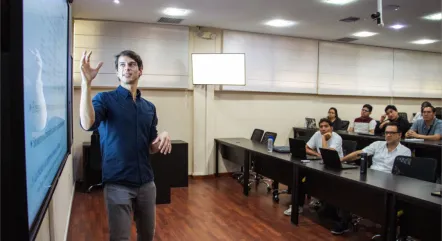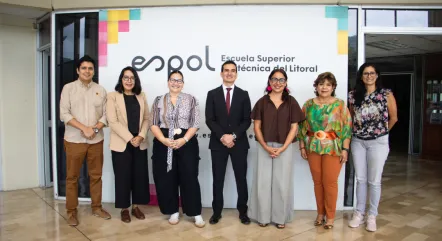


On October 21 and 22, Ronald Campoverde, professor and researcher at the Faculty of Social Sciences and Humanities (FCSH), took part in the International Congress on Business Innovation and Applied Research in Lima.
At this academic event, the researcher, invited by the Universidad de Lima, presented the paper “Leapfrogging and Bottom-Up Adoption: The Impact of Generative AI in Peru.” Leapfrogging is a term used to describe a strategy or phenomenon in which a company, an industry, or a developing country skips the intermediate or traditional technological stages and moves directly to more modern or efficient solutions.
In this context, Professor Campoverde’s presentation shared some key ideas about bottom-up technology adoption. According to his study, generative artificial intelligence does not reach companies through a top-down hierarchy. In fact, it happens the opposite way: students experiment with it at university and then bring those practices into the workplace. As a result, companies now value critical thinking and active supervision of AI’s work more than knowing how to code or analyze data. The advantage will not come from using AI, but from learning faster with it.
The International Congress on Business Innovation and Applied Research is a two-day event that brings together researchers, academics, specialists, and professionals from the business, academic, and government sectors. Its goal is to discuss the challenges and opportunities of innovation in today’s world.unidades de la innovación en el entorno actual.