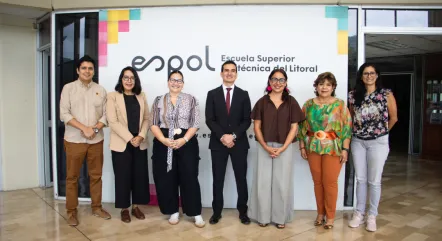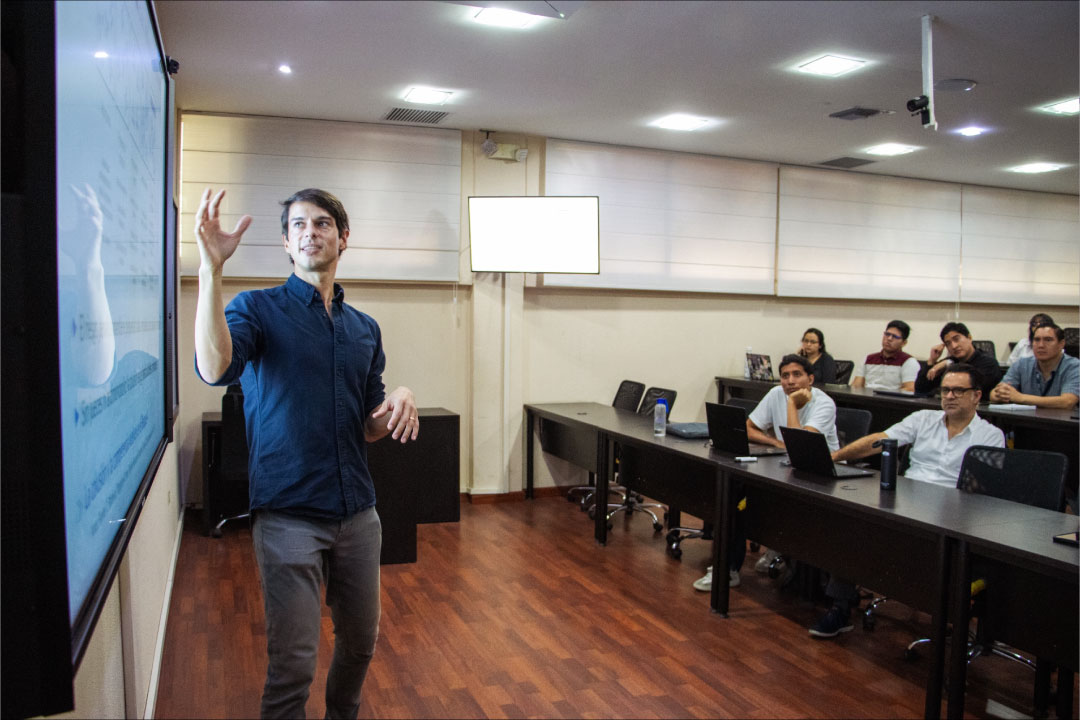


Economist Eduardo Montero, professor at the Harris School of Public Policy at the University of Chicago, visited Espol’s Faculty of Social Sciences and Humanities (FCSH) to lead the in-person workshop Approaches to the Analysis of Illicit Markets, held on October 15 and 16.
The visit was part of the sixth edition of the international conference Reducing Poverty in Latin America, a gathering that brought together scholars from the United States, the United Kingdom, Singapore, Argentina, Brazil, Colombia, and North Macedonia. While most of the presentations were delivered virtually, Montero’s workshop was one of the in-person activities, which gave the polytechnic community direct contact with the researcher.
During the session, participants learned about applications of three families of methods from contemporary empirical economics: spatial regression discontinuity designs, difference-in-differences with trend controls, and standard randomized controlled trial techniques. Montero explained how these tools are used to study the emergence of illicit markets and to generate critical data that allow public decisions to be grounded in evidence.
The topic is especially relevant for Ecuador and the region. For FCSH students and researchers, the workshop offered tools applicable to their own projects.
Montero is also a research affiliate of the National Bureau of Economic Research (NBER) and the Bureau for Research and Economic Analysis of Development (BREAD). His areas of interest are development economics, political economy, and economic history.
The conference also included presentations on artificial intelligence and democracy, determinants of child mortality using machine learning, education in Chilean schools, and the impact of AI on labor markets in Colombia and Latin America, among others that shed light on some of the economic and well-being dimensions of the region.