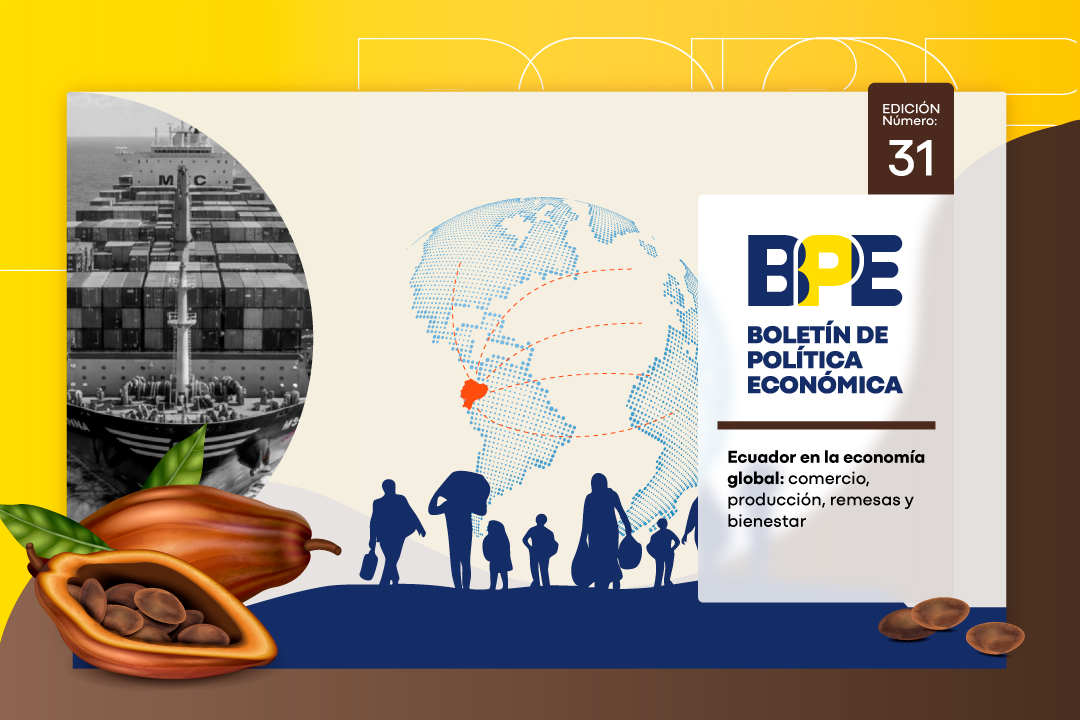


The Center for Economic Research (CIEC) of the Faculty of Social Sciences and Humanities (FCSH) presented the 31st edition of the Economic Policy Bulletin, a biannual publication whose central theme is: Ecuador in the Global Economy: Trade, Production, Remittances, and Well-Being.
Through its current affairs section and four research articles, this issue offers empirical evidence to understand both Ecuador’s structural position in global trade networks and the domestic mechanisms that shape the quality of life of Ecuadorian households.
During the presentation, Leonardo Sánchez, FCSH professor and researcher, discussed his article Connected or Peripheral? Ecuador’s Position in the Global Trade Network. The study measures the country’s position in the global export network using network analysis tools. Sánchez explained that in international trade, it is not enough to know how many markets a country exports to; the quality of those relationships also matters. Ecuador sells to 135 countries, more than the typical country, which sells to about 120. However, only 8 of those relationships are significant: the United States, China, Panama, Chile, Peru, Spain, the Netherlands, and Colombia. Moreover, its sales carry little weight in what those partners buy.
Sánchez added that Ecuador is a terminal node: a country that goods flow into and out of, but through which trade between other countries barely passes. It ranks 128th out of 162 in betweenness (intermediation), while Colombia ranks 16th. This limits its logistics activity and alternative routes if a partner stops buying from it. As a policy implication, he stressed the need to distinguish export volume from a country’s position in the network. Improving that position could require investment in ports and customs logistics, as well as legal stability to attract logistics services.
The forum also featured the presentation of the article The Ecuadorian Cocoa Sector in International Perspective: Evolution, Positioning, and Challenges by Juan Rizzo, CIEC researcher. He noted that in 2024, Ecuador was the third-largest exporter of cocoa beans, with a share of nearly 8% of world production. However, at the start of 2026, the sector experienced a drop in export value as well as a decline in the price per ton. In this context, Rizzo highlights that what matters is the sustainability of exports, not their volume. Along these lines, he presented figures showing that 90% of cocoa exports are in bean form, while 10% are processed products (liquor and paste). This reflects a lack of diversification toward finished products, which would generate stable demand, additional profit margins, and less dependence on exporting beans, which are sensitive to international prices. In conclusion, he states that the challenge is not to export more, but to turn surplus revenue into technological upgrading of the sector and improvements in marketing, which would provide the desired sustainability.

The 31st edition of the Economic Policy Bulletin is complemented by two articles on the theme Households, Well-Being, and the Measurement of the Economy. One, authored by José Gabriel Castillo, FCSH professor and researcher, evaluates the effect of remittances on neonatal health in Ecuador. Finally, the fourth article, written by Gustavo Solorzano, also an FCSH professor, offers a historical and conceptual review of Gross Domestic Product.
This new edition is available on the CIEC website: https://www.ciec.espol.edu.ec/sites/default/files/BPE_31_Octubre_2026.pdf?csrt=15460597141402834653