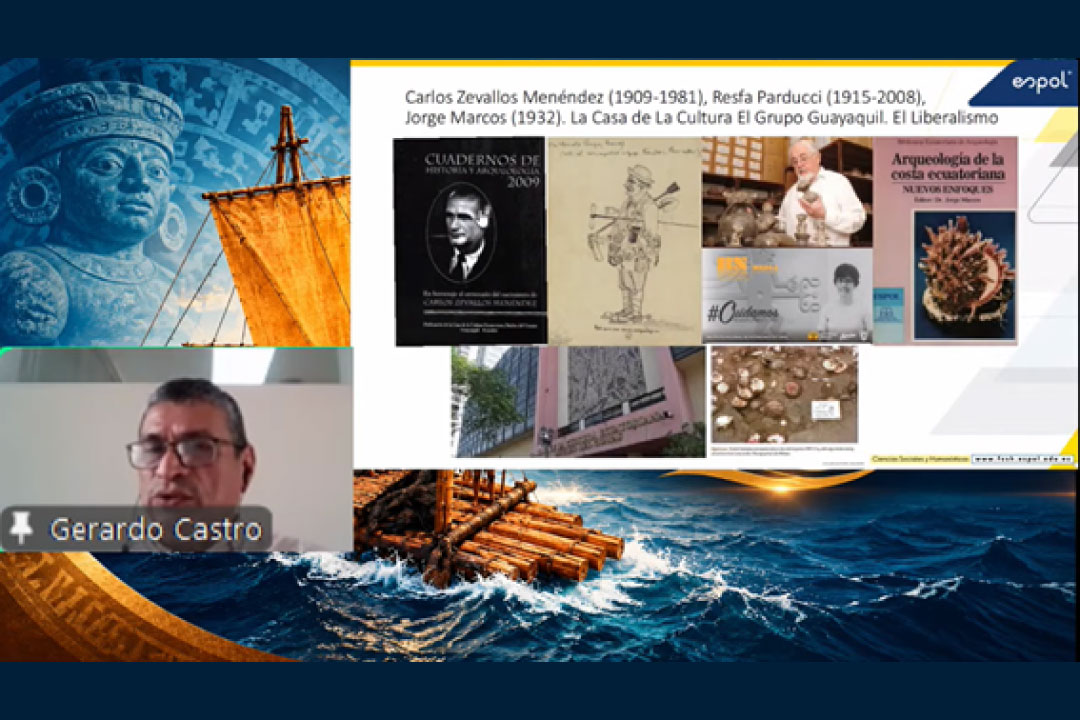

Professor Gerardo Castro, from the Archaeology program at the Faculty of Social Sciences and Humanities, took part in the International Symposium “500 Years Since the Encounter with the Manteña Raft,” held on October 6 and 7, 2026, in Manta. The event was organized by the Civic Committee for the Historical Memory of Manta and the Eloy Alfaro University of Manabí. In his talk, Professor Castro shared the progress of his project, Archaeology and History of the Diaspora of the Equatorial Sea.
The project received a grant from the Funding Line of the National Institute of Cultural Heritage. It reconstructs the voyages of the seafaring peoples of the Bahía culture (500 BCE to 500 CE) and the Manteña culture (500 to 1500 CE). Their rafts sailed across the Tropical Eastern Pacific toward Colombia, Panama, Costa Rica, and Mexico.
Building on this, Professor Castro raised a debate that Ecuadorian archaeology has had since the 1970s: whether the Galápagos Islands were part of this seafaring network. Some researchers have suggested that there are archaeological sites on Santa Cruz, Isabela, and San Cristóbal, and the Charles Darwin Foundation holds a collection of materials with heritage value. He also returned to the discussion about possible contact with the South Pacific, based on similarities between Manteña iconography and that of Rapa Nui.
The project’s contribution goes beyond archaeology. The research combines the archaeological record with history and oral tradition. It also recognizes traditional fishers and divers as keepers of knowledge. They understand the yearly patterns of currents, winds, rains, and marine migrations, knowledge that was also key to ancient raft navigation.
One important case in the project is the Balseros of General Villamil Playas, who were declared Intangible Heritage of Ecuador in 2014. The project also looks at the sailing trips on balandras (small sailing boats) from Guayaquil, Manta, Panama, and Acapulco to the Galápagos during the 19th and 20th centuries. In addition, the study considers the potential of the archipelago’s underwater heritage, based on shipwrecks mentioned in historical documents and oral memory, within the framework of the UNESCO Convention on the Protection of the Underwater Cultural Heritage.
Through this work, Professor Castro hopes to help preserve this knowledge and strengthen the social memory of the settlement of the Galápagos. His proposal connects natural capital with cultural heritage, for the benefit of fishing and diving communities.