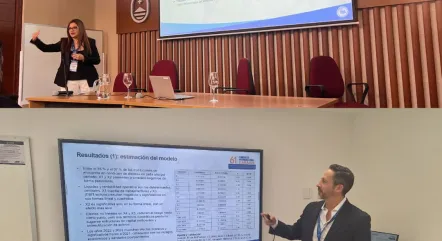


The Center for Economic Research (CIEC) of the Escuela Superior Politécnica del Litoral (Espol) was responsible for evaluating the impact of the project Digital Skills and Job Support, promoted by the Ministry of Labor. The results were presented on November 10 in Quito and on November 11 in Guayaquil at the Skills for the Future event, organized by the Inter-American Development Bank (IDB), the project’s strategic partner.
According to data presented by the IDB, only 1 in 3 young people in Ecuador is employed, while 43% of companies report difficulties filling their vacancies. To close this gap and generate evidence to guide public policy, this project was launched, targeting young people between the ages of 18 and 35.
The initiative ran from 2024 to August 2026 and was structured around three pillars: digital training, job placement, and evaluation. The first offered digital marketing courses; the second provided job guidance and support to about 1,800 young people across 11 provinces. The third pillar was led by CIEC, which measured the program’s impact.
Gonzalo Sánchez, director of CIEC, explained that to know whether a project works, it is necessary to identify which interventions improve outcomes and to estimate what would have happened to the beneficiaries had they not received them. For this reason, the evaluation sought to estimate the causal effect of the project on employment.
The results show that digital training had no statistically significant effect on job attainment. In contrast, job support, part of the job placement pillar, increased the probability of a young person being employed by about 4 percentage points.
According to the CIEC director, these findings offer guidance for public policy. On the one hand, young people need to strengthen their skills for job interviews and problem-solving, and they need greater contact with employers and vacancies. On the other, the evaluation highlighted a positive result: the State’s intervention through the project improved young people’s optimism and motivation, as well as their knowledge of how to approach job interviews and problem-solving.
The study also analyzed barriers to participation, including the difficulty of reaching young people by email or phone in a context of distrust. Among its recommendations, CIEC noted that training initiatives should be adapted to young people’s realities and incorporate mechanisms for feedback, follow-up, and validation of communication channels.
CIEC at Espol’s mission is to generate information, research, analysis, and knowledge in economics and business management, in order to meet the demand and interests of the productive sectors and of society at large.