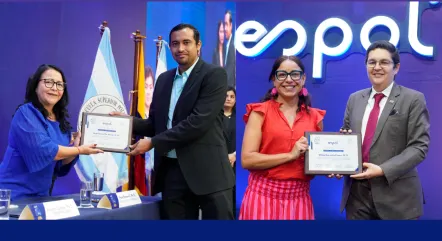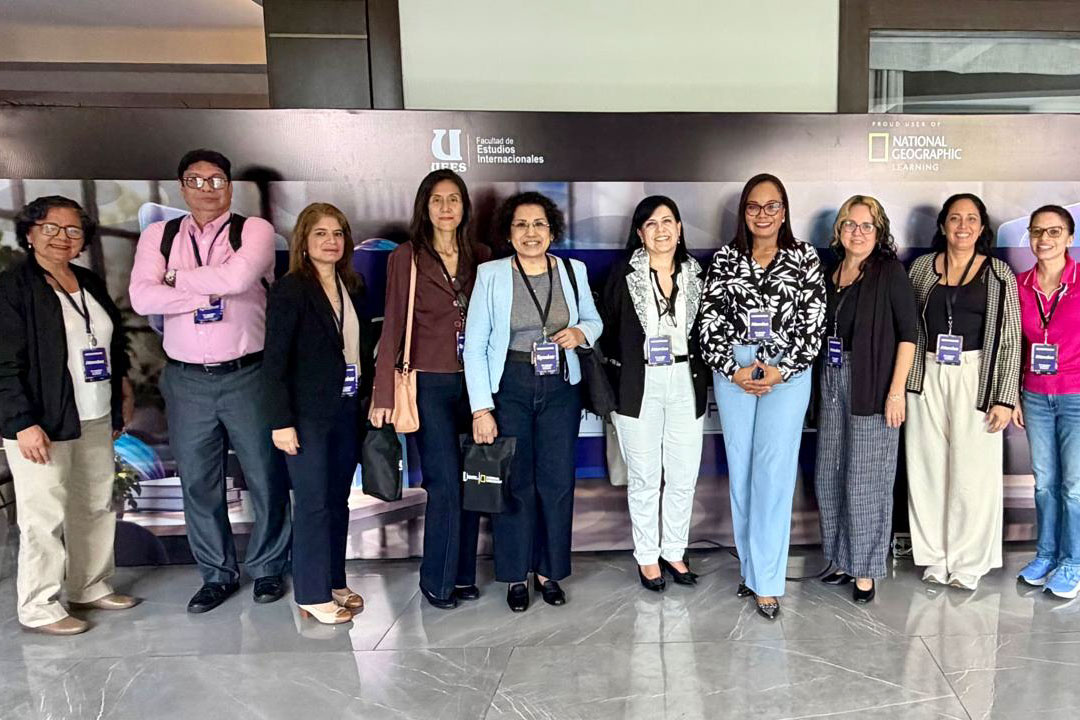


A delegation from the Foreign Language Center (CELEX) of ESPOL’s Faculty of Social Sciences and Humanities took part in the 2nd English Language Teaching Congress, organized by Universidad de Especialidades Espíritu Santo (UEES).
Some members of the delegation participated as speakers and experts, alongside colleagues from the United Kingdom, the United States, and South Africa, as well as guests from National Geographic Learning. The theme of the event was The Re-imagined Classroom: Teaching Skills for the Future.
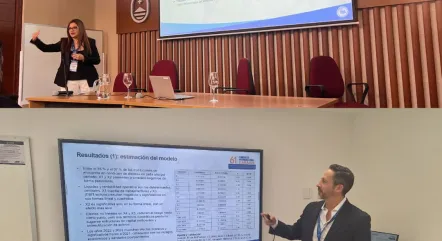
One of the talks was given by professor David Estrella. It was titled Rethinking Scaffolding in EFL Writing. Scaffolding is a strategy in which teachers give students temporary, adjusted, and guided support so they can complete a task they could not do alone. In this case, the task was writing. According to Professor Estrella, English writing activities should always have a purpose and a set time limit so that students can become independent.
Another presentation was given by professors María Helen Camacho, Janella Maldonado, and Jenny Villarreal. Their topic was Beyond Prompts: Designing AI-Powered Speaking Tasks. It was a practical workshop about using artificial intelligence to design more dynamic, authentic, and interactive speaking activities. They also presented the 5Cs framework (Choice, Challenge, Contrast, Communication gap, and Change), which aims to make communication meaningful and spontaneous instead of memorized.
Professor Jenny Villarreal also represented ESPOL in the closing plenary session of the event, called Teaching Skills for the Future at the UEES 2nd English Language Teaching Congress. In this round table, she shared her experience and thoughts on the challenges and opportunities of artificial intelligence in education. She also talked about the importance of using it in a critical, ethical, and pedagogical way in the teaching and learning of English as a foreign language.
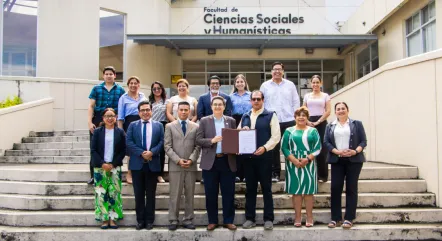
The delegation also included CELEX director Nadia Chalá and professors Albania Cadena, María Cristina Faytong, Laura Mariscal, Wendy Rivera, Karina León, and Alina Álvarez.
Most CELEX teachers have a Master’s degree in Teaching English as a Foreign Language, and they hold a C1 or C2 level according to the Common European Framework of Reference for Languages (CEFR). They also have other certifications that support their experience and knowledge in teaching this language.