
A scientific study published in a journal of the Nature group offers new insights into the organization of domestic spaces and food-preparation practices among the societies that once inhabited the Upano Valley in the Ecuadorian Amazon.
The study, titled "Combustion and cooking areas at El Edén archaeological site, Upano Valley, Ecuador—650 BP," was published in npj Heritage Science, part of the prestigious Nature Portfolio, a publishing group recognized worldwide for hosting some of the most influential and rigorous scientific publications.
The paper was developed by researchers from ESPOL's Archaeology program in the Faculty of Social and Human Sciences, Andrés Mosquera and Álvaro Mora, together with Lorena Merino, Jennifer Orozco, Carlos Correa Jaramillo, Luis Contreras, and Roberto Ordóñez. The research focused on the El Edén archaeological site, located in the Upano Valley, Morona Santiago province, one of the most important regions for understanding the development of Amazonian societies.
Reconstructing daily life among ancient Amazonian societies
The study's main objective was to identify and characterize combustion- and food-preparation-related activity areas at the El Edén site, contributing to an understanding of how domestic spaces were organized during the valley's later occupation periods. Although previous research has documented the existence of mounds, plazas, and complex settlement networks in the region, relatively little has been known about the daily activities carried out by its inhabitants within their living spaces.
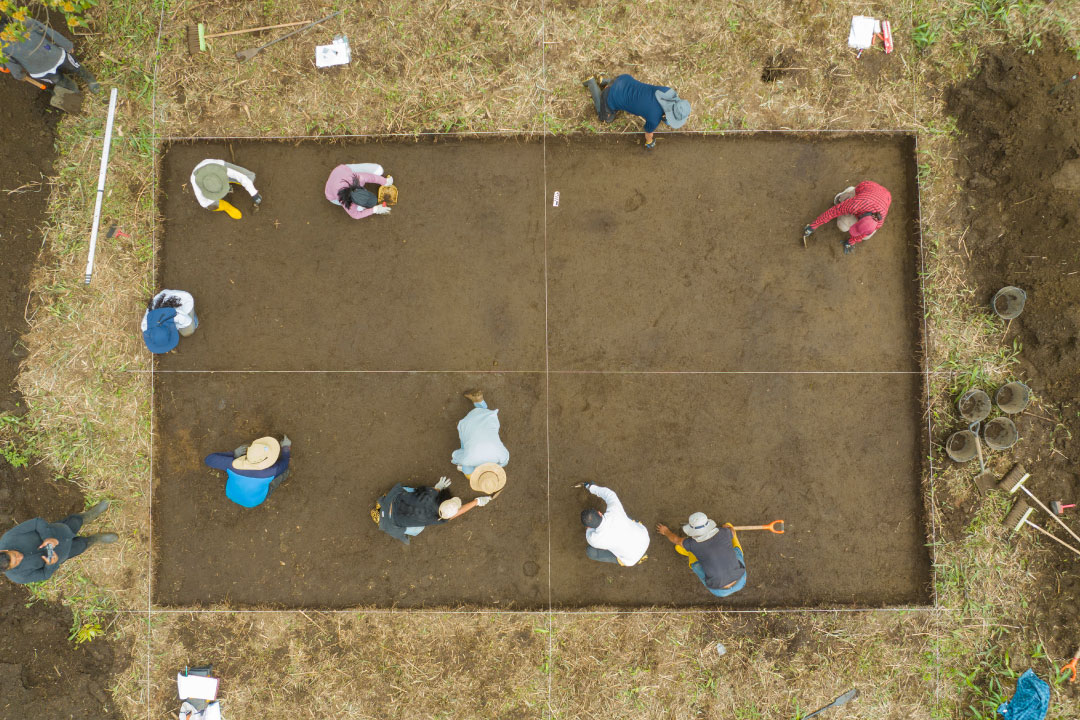
To address this question, the team applied an innovative multi-proxy methodology that integrated archaeological, geochemical, and paleoethnobotanical evidence. This approach combined information from archaeological excavations, chemical analysis of sediments using X-ray fluorescence (XRF), and phytolith studies—microscopic plant structures that remain preserved in soils for centuries.
Evidence of food preparation and organized use of space
The results revealed that the inhabitants of El Edén had developed a clearly defined spatial organization for their domestic activities.
Researchers identified areas associated with hearths, compacted floors, postholes, and concentrations of ceramic fragments showing signs of fire exposure. The recurring distribution of these elements made it possible to identify spaces dedicated to food preparation and consumption.
Geochemical analyses detected elevated concentrations of phosphorus, calcium, and zinc in certain sectors—indicators commonly associated with domestic activities related to cooking and food handling. In addition, phytolith studies identified remains of species cultivated and used by these populations, including maize (Zea mays), cassava (Manihot esculenta), Amazonian palms, and possible evidence of achiote/annatto (Bixa orellana).
The convergence of these lines of evidence allowed for a more precise reconstruction of the daily practices of the communities that occupied the site, demonstrating that domestic spaces were organized in a functional and specialized manner.
A contribution to the knowledge of pre-Columbian Amazonia
Archaeological evidence accumulated over recent decades shows that numerous Amazonian societies developed complex forms of territorial organization, landscape management, and food production. The study conducted at El Edén now provides a more detailed level of analysis, focused on the daily life and domestic dynamics of these populations.
The research also demonstrates the value of integrating traditional archaeological techniques with advanced scientific tools to reconstruct aspects of the past that are not visible to the naked eye. This kind of interdisciplinary approach allows for a better understanding of the relationships between people, natural resources, and the territories they inhabited.
Ecuadorian science with international impact
The publication of this work in npj Heritage Science, an indexed journal of the Nature Portfolio group, represents an important recognition of the quality of archaeological research conducted in Ecuador and strengthens the international visibility of studies on Amazonian cultural heritage.
It also reflects the commitment of ESPOL and its researchers to generating high-level scientific knowledge that contributes to understanding the country's history and cultural diversity from an interdisciplinary and innovative perspective.
The full article can be read at: https://www.nature.com/articles/s40494-026-02686-2